App icon for MTG Life Counter: Lotus
MTG Life Counter: Lotus Track life and commander damage for up to 10 players
Launch
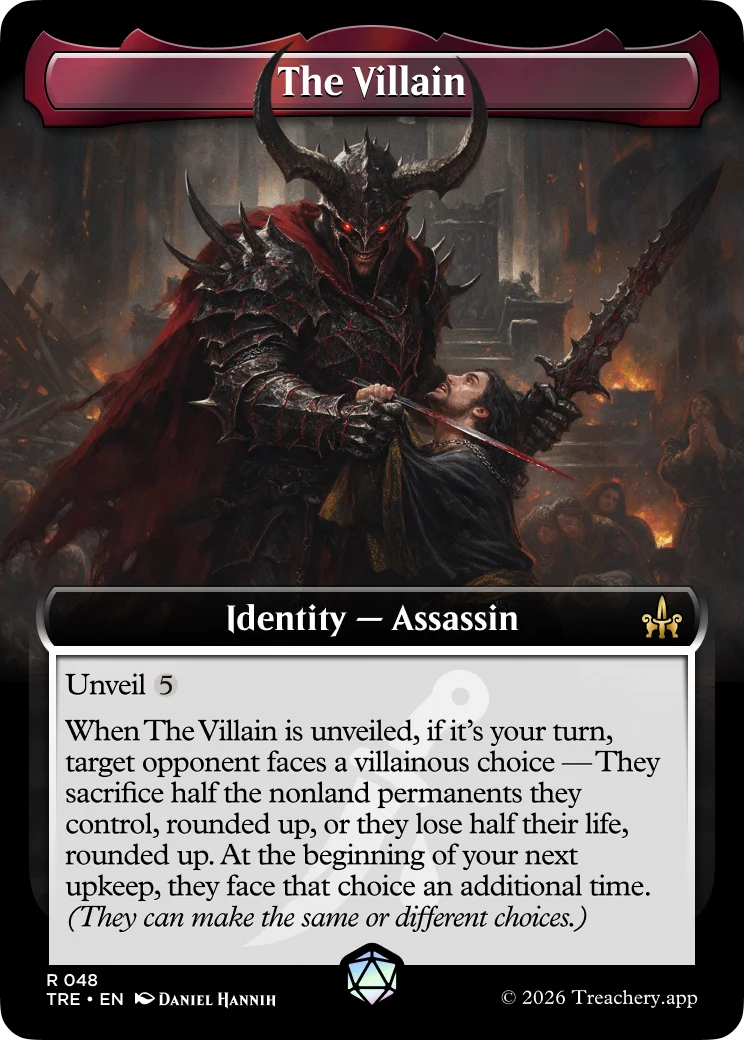
The Villain, Assassin identity card from MTG Treachery
The Villain {5}
Identity — Assassin
Unveil {5} When The Villain is unveiled, if it’s your turn, target opponent faces a villainous choice — They sacrifice half the nonland permanents they control, rounded up, or they lose half their life, rounded up. At the beginning of your next upkeep, they face that choice an additional time. (They can make the same or different choices.)
TRE · 048/062 · R

Assassin

The Villain

#48 · Rare Rarity means complexity, not power

Identity — Assassin

Unveil {5}

When The Villain is unveiled, if it’s your turn, target opponent faces a villainous choice — They sacrifice half the nonland permanents they control, rounded up, or they lose half their life, rounded up. At the beginning of your next upkeep, they face that choice an additional time. (They can make the same or different choices.)

Unveil cost
{5} · mana value 5
Team
Assassin team

Playing an Assassin

Hidden among the table, working with the other Assassins to bring the Leader down.

How you win: Your team wins when all Leaders have lost and at least one Assassin is still in the game.

Roles and win conditions in the rules →

Rulings

  • When a player faces a villainous choice, they first choose one of the two options, then all actions in the chosen option are performed.
  • A player facing a villainous choice can always choose either option, even if one or both of the options are impossible. For example, if one of the options is to sacrifice a creature, a player who controls no creatures can still choose that option.
  • If a player attempts to halve a negative life total, they halve 0. This means that the life total stays the same. A life total of -10 would remain -10.
  • All abilities that trigger while The Villain’s unveiling triggered ability is resolving are put on the stack after it is finished resolving. All such abilities controlled by the player whose turn it is are put on the stack first, then those controlled by the next player in turn order, and so on. For each player, they can put their abilities on the stack in the order of their choice. Abilities don’t have to be put on the stack in the order in which they triggered.