App icon for MTG Life Counter: Lotus
MTG Life Counter: Lotus Track life and commander damage for up to 10 players
Launch
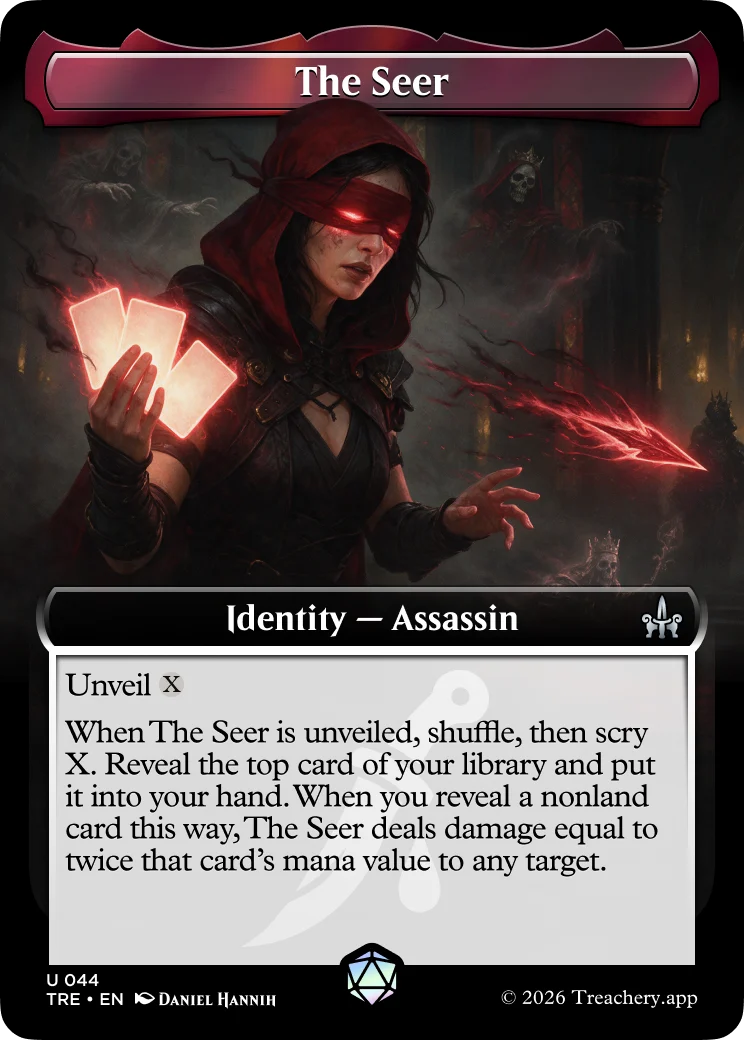
The Seer, Assassin identity card from MTG Treachery
The Seer {X}
Identity — Assassin
Unveil {X} When The Seer is unveiled, shuffle, then scry X. Reveal the top card of your library and put it into your hand. When you reveal a nonland card this way, The Seer deals damage equal to twice that card’s mana value to any target.
TRE · 044/062 · U

Assassin

The Seer

#44 · Uncommon Rarity means complexity, not power

Identity — Assassin

Unveil {X}

When The Seer is unveiled, shuffle, then scry X. Reveal the top card of your library and put it into your hand. When you reveal a nonland card this way, The Seer deals damage equal to twice that card’s mana value to any target.

Unveil cost
{X} · mana value 0, X counts as 0
Team
Assassin team

Playing an Assassin

Hidden among the table, working with the other Assassins to bring the Leader down.

How you win: Your team wins when all Leaders have lost and at least one Assassin is still in the game.

Roles and win conditions in the rules →

Rulings

  • The Seer’s unveiling triggered ability goes on the stack without a target. When you reveal a nonland card during its resolution, its reflexive triggered ability triggers and you pick a target to be dealt damage. You’ll know the mana value of the revealed nonland card and how much damage will be dealt as you choose your target.
  • The X in the unveiling triggered ability has the same value as the X paid in the Unveil ability. This is pretty easy to derive since there is no other source of X.
  • If X is 0, you won’t scry at all. Any abilities that trigger whenever you scry won’t trigger.
  • Once The Seer’s unveiling triggered ability begins to resolve, no player may take other actions until it’s done. Notably, opponents can’t try to change your library after you scry but before you reveal the top card of your library.
  • If the revealed card in your library has {X} in its mana cost, X is considered to be 0.
  • The converted mana cost of a split card is based on the combined mana cost of its two halves.
  • An identity card has no color.