
Setup
Setting up a game
Five minutes from shuffled decks to the Leader’s first turn, whether you deal paper cards or use your phones.
What you need
- Four or more players, ideally five to seven.
- A deck each. Treachery is built for Commander, but any multiplayer-friendly decks work.
- One identity per player. Either a printed set of identity cards, or a phone each running Treachery.app. No cards at all? Use basic lands (see variants).
- Life counters, as for any Commander game.
Setting up on paper
- Choose decks first. Everyone settles on a deck before seeing an identity. No swapping afterwards.
- Sit down. Settle seats now, so where someone sits never says anything about their role.
- Build the identity deck. Take exactly one identity per player, using the role counts below. Sort the identity cards by role first so you can pick the right number of each without seeing which card you pick.
- Announce the counts. Tell the table how many of each role are in the deck. That part isn’t secret.
- Shuffle and deal. One identity face down to each player. Look at yours without showing anyone.
- Reveal the Leader. The Leader turns their card face up in the command zone. Everyone else puts theirs face down next to their commander.
- Apply start-of-game effects. Some Leaders change their starting life, hand size or counters. Do that now.
- Life and hands. 40 life in Commander (20 otherwise), seven cards, normal mulligans.
- Play. The Leader takes the first turn. Turns go around the table as usual.
Keep the unused identity cards out of sight but nearby. A few identities, like The Wearer of Masks, reach into the cards that weren’t dealt.
Setting up with Treachery.app
- One player hosts. Open Host a game, enter your name and create the table.
- Everyone joins. Players scan the QR code or type the game code on their own phones. Someone without a phone can be added as a guest on the host’s phone.
- Pick the identity pool. Choose which rarities to deal from and ban any identities you don’t want. The app shows whether the pool has enough of each role.
- Start. The app works out the role counts for your player count and deals on the server, so each phone only ever receives its own identity. The Leader is announced to the whole table.
- Play. Hold to peek at your identity. Unveil from your phone when the time comes; the app checks Undercover for you, tracks who is out and calls the winning team.
How many of each role
Every game has exactly one Leader and at least one Traitor. Roughly half the table are Assassins. For four to eight players, use the recommended table:
| Players | Leader | Guardian | Assassin | Traitor | Leader team vs Assassins |
|---|---|---|---|---|---|
| 4 | 1 | 0 | 2 | 1 | 1 vs 2 |
| 5 | 1 | 1 | 2 | 1 | 2 vs 2 |
| 6 | 1 | 1 | 3 | 1 | 2 vs 3 |
| 7 | 1 | 2 | 3 | 1 | 3 vs 3 |
| 8 | 1 | 2 | 3 | 2 | 3 vs 3 |
| 9* | 1 | 2 | 4 | 2 | 3 vs 4 |
| 10* | 1 | 2 | 5 | 2 | 3 vs 5 |
| 11* | 1 | 3 | 5 | 2 | 4 vs 5 |
| 12* | 1 | 3 | 6 | 2 | 4 vs 6 |
Not in the official table. Worked out from the general rule: one Leader, half the players (rounded down) as Assassins, at least one Traitor, the rest Guardians. This is what Treachery.app deals.
The formula behind it
The general rule, which also covers bigger groups:
- One Leader. Never more.
- Assassins equal to half the players, rounded down. 9 players get 4, 10 players get 5.
- At least one Traitor.
- Everyone else is a Guardian, or another Traitor if you want more chaos.
For 9 or more players, Treachery.app splits the seats left after the Leader and the Assassins in half: half Traitors (rounded down), half Guardians. That is the same split the official table uses at 4–8 players, so 9 players get 2 Guardians and 2 Traitors, and 12 players get 3 Guardians and 2 Traitors.
One quirk: at 8 players the recommended table has 3 Assassins, but “half the players” would be 4. The table is the recommended setup and is what Treachery.app deals. If your group prefers the strict formula, swap a Guardian for a fourth Assassin.
Why five to seven is the sweet spot
At four players there are no Guardians, so anyone who isn’t attacking the Leader is probably the Traitor. From five players there is real doubt about every hidden card. Above eight, games get long, so consider faster decks.
Decks and power level
- Match power levels. The Leader is a public target for half the table. A Leader on a slow, unfocused deck facing tuned Assassin decks won’t last, and nobody learns anything from that game.
- Bring decks that can attack and defend. You don’t know your role when you choose. Removal, instant-speed interaction and a way to pressure one player are useful in every role.
- Go easy on infinite combos. A combo that wins on the spot skips everything that makes Treachery fun: the suspicion, the deals, the dramatic unveils. Many groups agree on a casual power level instead.
- Mass removal is fine. Board wipes hit everyone, and that’s part of the game. Just remember the Leader usually suffers most from them.
- Political cards shine. Offers, “each player may” choices and goad turn every decision into a tell, which is exactly what a hidden-role game feeds on.
Banlist
Treachery uses the banned list of the format underneath it. For Commander, that means the official Commander banned list. On top of that, the Treachery designers strongly suggest leaving out three Magic cards:
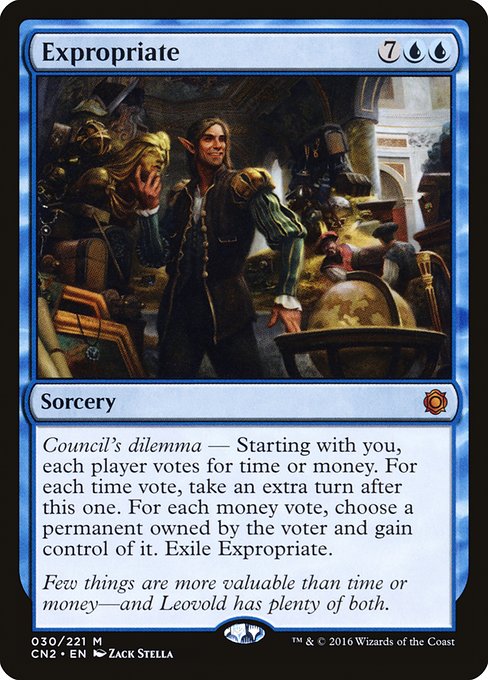
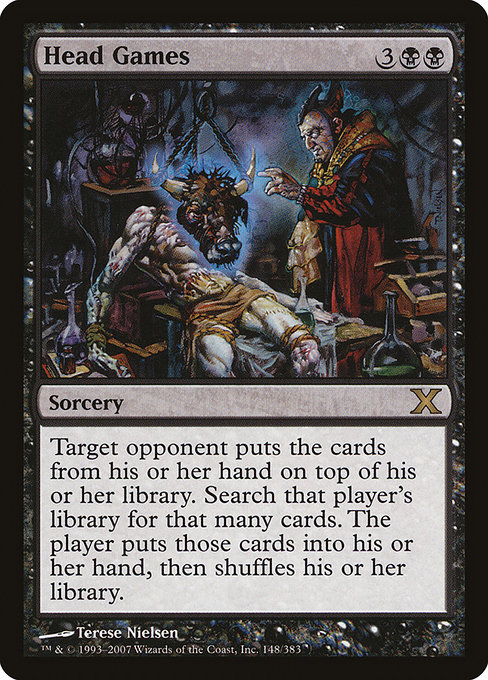
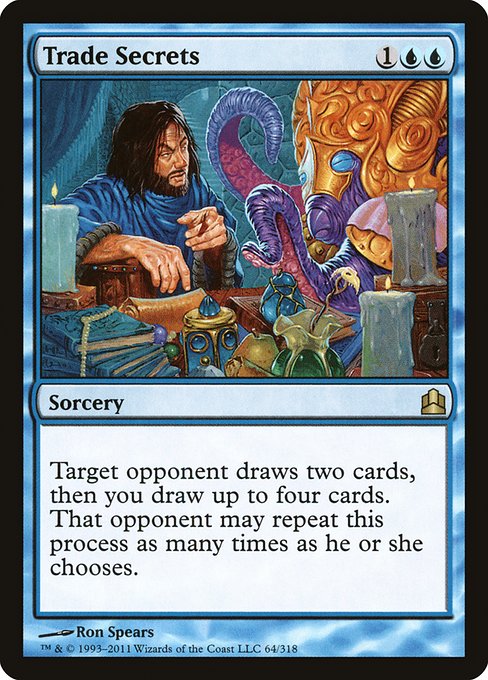
No identity is banned, but plenty of groups remove a few of the swingiest ones. Treachery.app lets the host ban any identity before dealing. See TR12 for the full rule and the variants page for which identities groups most often leave out.
Before the first turn
- Everyone knows the role counts.
- House rules and variants are agreed, including how you settle ties (TR6.9d).
- The Leader is face up and every other identity is face down in the command zone.
- Start-of-game effects from the Leader are applied.
- Life totals are set and hands are kept.
- Everyone remembers the golden rule: trust no one.